Choosing a China Top Liquid Cooling Battery Storage Cabinet Supplier requires more than comparing prices and product photos. A dependable partner should demonstrate engineering experience, stable manufacturing, and clear communication. This article examines how suppliers design and produce a Liquid Cooling Battery Storage Cabinet for demanding energy storage projects.
In practice, cabinet performance depends on details that are easy to overlook. Review the cooling circuit, pump redundancy, temperature sensors, fire protection, battery management system, and enclosure rating. Ask for thermal test data, cycle results, factory inspection records, and references from comparable installations. A credible supplier should explain how the cabinet maintains balanced temperatures during peak loads and hot outdoor conditions. It should also provide wiring diagrams, maintenance procedures, spare-parts guidance, and realistic delivery timelines.
Small details matter.
A serious evaluation should include a factory audit, sample testing, and technical discussions with experienced engineers. Request evidence of relevant quality systems and recognized product certifications. Check whether the supplier can customize voltage, capacity, communication protocols, and installation layouts without weakening safety controls. Experience matters, but documentation matters too.
Still, no supplier is perfect. Marketing language may hide limitations, especially around efficiency, noise, or performance in extreme climates. Buyers should question impressive claims and compare measured results instead. A responsible supplier will discuss risks openly, including cooling failures, condensation, servicing access, and future battery replacement. This guide helps purchasers assess technical capability, operational reliability, and long-term support before selecting a China-based supplier. It also encourages careful reflection: the cheapest cabinet may create higher costs later. That honesty is valuable.
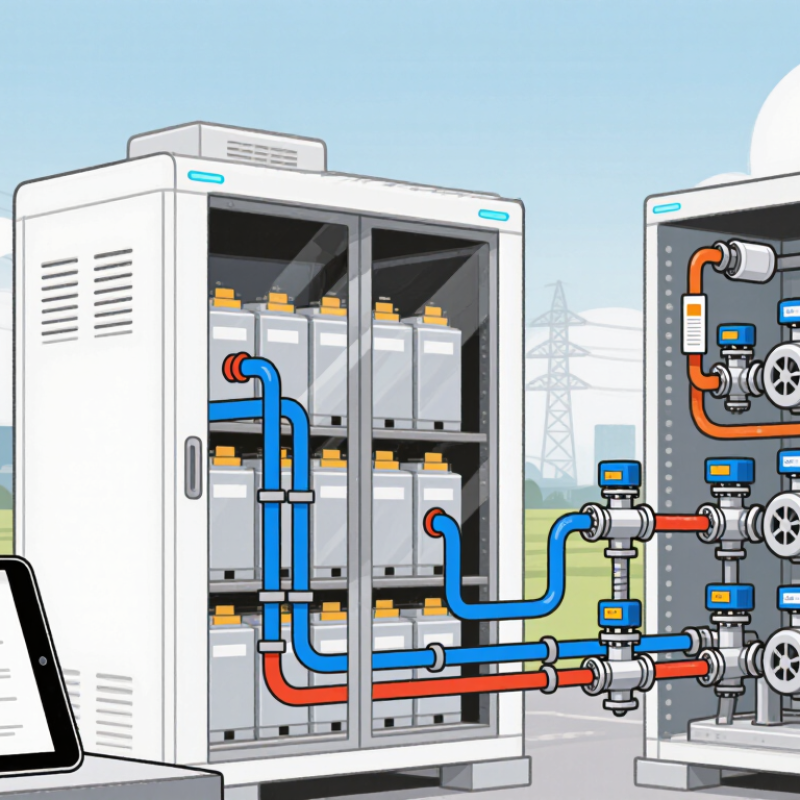
Liquid cooling battery storage cabinets house battery modules inside a controlled thermal system. A pump circulates coolant through cold plates or cooling channels near the cells. This design removes heat more evenly than air cooling, especially during fast charging and high-power discharge. The cabinet also integrates a battery management system, temperature sensors, leak detection, fire detection, and communication interfaces. Its core function is not only cooling. It helps control temperature differences, protect battery life, and support stable power output.
The International Energy Agency reported about 42 GW of new battery storage capacity added in 2023. This rapid growth increases the need for reliable thermal management. A practical cabinet should maintain consistent cell temperatures, respond quickly to abnormal heating, and isolate faulty modules when necessary.
NFPA 855 and UL 9540A testing provide useful safety references for system design and fire-risk evaluation. Still, no cabinet is maintenance-free. Pumps can fail. Seals can age. Installation quality remains decisive.
Tips: Ask suppliers for temperature-uniformity data, coolant specifications, protection levels, and test reports. Check performance under summer heat and winter cold. Request clear service intervals. A low purchase price may hide higher maintenance costs. Do not judge cooling quality from appearance alone. Real operating data matters more.
China Top Liquid Cooling Battery Storage Cabinet Supplier?
Liquid cooling is reshaping energy storage cabinet design. The system uses cold plates, pumps, heat exchangers, and temperature sensors. Coolant removes heat directly from battery modules. This supports tighter temperature control than traditional air cooling. In practice, stable temperatures can reduce cell imbalance and slow capacity degradation. However, pump failure remains a serious risk. Every cabinet needs pressure monitoring and an emergency bypass.
The International Energy Agency’s 2024 Batteries and Secure Energy Transitions report estimates global battery storage must reach about 1,200 GW by 2030. That expansion demands safer and denser thermal management. A well-designed cabinet should keep module temperature differences within approximately 3°C. It should also record inlet temperature, outlet temperature, flow rate, and abnormal pressure. These details help engineers trace faults instead of guessing.
Fire detection must work with the cooling system. UL 9540A testing can evaluate thermal runaway propagation under realistic conditions. A reliable supplier should provide test records, cycle-life data, ingress protection results, and clear maintenance procedures. Look inside the cabinet. Hoses should be protected from sharp edges. Electrical parts should remain isolated from coolant paths. No cabinet is maintenance-free. That assumption needs challenging. Seasonal testing, filter inspection, and sensor calibration still matter. A strong design combines liquid cooling, battery management software, early gas detection, and documented factory testing.
Liquid cooling cabinets commonly use cold plates, a pump-driven coolant loop, temperature sensors, expansion or buffer tanks, and BMS-controlled thermal management. The chart shows representative operating temperature envelopes commonly specified for lithium iron phosphate (LFP) battery systems; exact limits depend on the cell design and system qualification.
Charging is typically restricted to approximately 0–45°C, while discharging can commonly operate from approximately −20°C to 55°C. Maintaining cells within a narrower recommended range helps improve safety, power performance, and service life.
A leading Chinese liquid cooling battery storage cabinet supplier should be judged by evidence, not catalog language. The International Energy Agency reported that global battery storage additions reached about 42 GW in 2023, rising nearly 130% year on year. This rapid growth makes supplier verification more important, especially for projects using high-density cabinets.
Check the supplier’s engineering experience first. Request project records showing cabinet capacity, operating temperature, fire-control design, and long-term availability. Factory audits should include cell traceability, welding quality, insulation tests, and end-of-line testing. Ask for measured round-trip efficiency, auxiliary consumption, cycle results, and response time. Marketing figures can be polished. Test conditions may not be.
Safety evidence deserves close attention. Review thermal propagation tests, liquid leakage protection, pressure relief, smoke detection, and emergency shutdown logic. Testing aligned with UL 9540A and installation planning consistent with NFPA 855 can improve confidence, but certificates alone are not enough. Site integration matters. The supplier should explain communication protocols, remote diagnostics, spare-part timing, and technician support in clear documents.
Price also needs context. BloombergNEF’s 2023 Battery Price Survey placed average lithium-ion pack prices at 139 dollars per kWh, down 14% from 2022. Lower component prices may support a competitive quotation, but they can also hide reduced controls or service scope. I would compare five-year operating assumptions, not only the purchase price. No supplier is perfect. A credible one admits limits, shares test data, and responds precisely when questions become uncomfortable.
Choosing a China-based liquid cooling battery storage cabinet supplier requires more than a low quoted price. The IEA’s Batteries and Secure Energy Transitions 2024 reports that global battery storage additions reached about 42 GW in 2023, rising over 130% year on year. This growth increases pressure on factories. A credible supplier should show controlled cell sourcing, documented welding parameters, and ISO 9001-based process management. Records should connect each cabinet to cell batches, firmware versions, and inspection results. Small gaps matter.
Safety design should align with applicable IEC 62619, GB/T 36276, and UL 9540 requirements. UL 9540A testing evaluates fire propagation and thermal runaway behavior across several levels. Liquid cooling requires independent temperature sensors, leak detection, pressure relief, smoke monitoring, and automatic electrical isolation. Fire suppression must match the battery chemistry and site risks. Water is not automatically wrong. It cannot be selected by habit.
Quality control appears in practical details: incoming cell capacity checks, insulation testing, torque verification, coolant cleanliness, and full-load factory acceptance testing. Request sample data, calibration dates, and nonconformance records. A reliable supplier should also perform vibration, humidity, low-temperature, and abnormal-operation tests. Market growth does not prove durability. Some suppliers show polished dashboards with thin evidence. That is a warning. Inspect the cooling loop physically, review alarm logic, and ask one uncomfortable question: what failed during internal testing, and what changed afterward?
China Top Liquid Cooling Battery Storage Cabinet Supplier?
Liquid cooling battery storage cabinets support renewable energy, peak shaving, microgrids, and high-power backup systems. They keep battery cells within a narrower temperature range during repeated charging and discharging. This matters in hot warehouses, coastal sites, and compact energy rooms with limited airflow. A practical design may include pumps, heat exchangers, sensors, fire separation, and remote alarms. Field experience shows that thermal performance depends on installation quality, not hardware alone.
Tips: Ask for measured cooling capacity, standby power, noise data, and emergency response logic. Request test reports under your expected temperature, load profile, and charging schedule. Check service access. A cabinet that is difficult to inspect can create avoidable downtime. Do not accept vague claims about safety, cycle life, or efficiency.
Customization should match the project, rather than decorate a standard enclosure. Useful options include cabinet capacity, voltage architecture, liquid loop layout, communication protocols, ingress protection, and cable entry positions. Suppliers should explain battery chemistry compatibility, warranty boundaries, spare-parts planning, and commissioning support. Ask for drawings before production, then verify clearances around doors, pipes, and maintenance panels. Independent certification and traceable factory testing strengthen reliability and procurement confidence. Still, every project has unknowns. Early load data may be incomplete, and that weakness deserves an honest review. Select a supplier with documented projects, responsive engineers, and transparent corrective-action records.
| Evaluation Dimension | Typical Technical Data or Requirement | Application Value | Customization Options | Supplier Selection Criteria |
|---|---|---|---|---|
| Core Product Type | Outdoor liquid-cooling battery energy storage cabinet integrating battery modules, liquid-cooling equipment, battery management system, power conversion interface, fire protection, and monitoring. | Provides a compact and coordinated solution for energy storage projects with limited installation space. |
|
Confirm whether the supplier provides a complete system or only the battery enclosure and thermal-management assembly. |
| Typical Energy Capacity | Common cabinet configurations are approximately 100 kWh to 1,000 kWh per cabinet, depending on cell chemistry, module arrangement, and enclosure size. | Supports commercial and industrial peak shaving, renewable-energy integration, and small- to medium-scale microgrids. |
|
Compare both nominal capacity and usable capacity at the specified depth of discharge, temperature, and operating conditions. |
| Battery Chemistry | Lithium iron phosphate cells are widely used because of their thermal stability, long cycle life, and suitability for stationary storage. | Offers a balance between safety, service life, energy density, and total ownership cost. |
|
Request cell traceability, incoming inspection records, consistency data, and documented safety-test results. |
| Power Rating | System power is selected according to the application, commonly from several hundred kilowatts to multiple megawatts when cabinets are connected in parallel. | Determines the system's ability to respond to demand peaks, grid commands, and renewable-energy fluctuations. |
|
Check whether the supplier can provide verified continuous power, short-term overload capability, and grid-compatible control functions. |
| Liquid-Cooling System | A liquid loop circulates coolant through cold plates or cooling channels connected to the battery modules. Temperature uniformity is normally targeted within a narrow range across the pack. | Improves heat removal, reduces temperature differences between cells, and supports consistent performance in high-power operation. |
|
Review cooling performance at full load, pump reliability, leakage protection, coolant maintenance requirements, and low-temperature operation. |
| Operating Temperature | Many systems are designed for a broad ambient range, often around -20°C to 50°C, subject to derating and project-specific configuration. | Allows deployment in outdoor environments and regions with seasonal temperature variation. |
|
Require documented performance curves rather than relying only on the stated ambient-temperature range. |
| Applications | Commercial and industrial storage, renewable-energy shifting, photovoltaic self-consumption, microgrids, backup power, demand-charge reduction, and ancillary grid services. | Enables energy-cost management, renewable-energy utilization, power-quality support, and resilience during grid interruptions. |
|
Select a supplier with reference projects that match the required operating profile, climate, grid code, and dispatch strategy. |
| Round-Trip Efficiency | System-level round-trip efficiency is commonly evaluated in the approximate range of 85% to 95%, depending on power level, auxiliary consumption, temperature, and test method. | Higher efficiency reduces energy losses and improves the economic return of frequent charge-discharge operation. |
|
Compare measured system-level results, including cooling, control, standby, and conversion losses. |
| Cycle Life | Stationary lithium iron phosphate systems may be specified for several thousand cycles, often subject to depth of discharge, temperature, charge rate, and end-of-life capacity criteria. | Longer cycle life can reduce replacement frequency and improve lifecycle economics. |
|
Check the test protocol, end-of-life definition, warranty exclusions, and whether the cycle claim applies to cells, modules, or the complete system. |
| Safety Architecture | Typical protection layers include cell monitoring, module-level detection, overcurrent protection, insulation monitoring, smoke and heat detection, fire suppression, pressure relief, and emergency shutdown. | Reduces the probability and consequences of thermal events while supporting safe operation and emergency response. |
|
Request third-party test reports, hazard-analysis documentation, installation clearances, and a clearly defined emergency-response procedure. |
| Ingress Protection | Outdoor cabinets are often specified with an enclosure rating such as IP55 or higher, depending on ventilation, service access, and project conditions. | Protects electrical components from dust and water exposure in suitable outdoor installations. |
|
Verify the tested enclosure rating, corrosion category, sealing design, and suitability for the actual installation environment. |
| BMS and EMS Functions | The battery management system monitors voltage, current, temperature, state of charge, state of health, balancing, alarms, and protective limits. The energy-management system controls operating schedules and power flow. | Improves operational visibility, battery protection, dispatch accuracy, and maintenance planning. |
|
Confirm protocol compatibility, cybersecurity controls, data ownership, remote-service permissions, and alarm-response responsibilities. |
| Grid and Electrical Compatibility | Important parameters include DC voltage range, AC voltage, frequency, transformer arrangement, grounding method, short-circuit requirements, and applicable grid-code functions. | Determines whether the cabinet can be integrated safely and legally with the project electrical system. |
|
Require a complete single-line diagram, protection coordination data, grid-compliance evidence, and interface responsibility matrix. |
| Installation and Maintenance | Cabinets require a level foundation, cable access, lifting provisions, service clearances, ventilation or heat-rejection space, drainage considerations, and safe isolation procedures. | Proper installation improves safety, uptime, serviceability, and long-term thermal performance. |
|
Evaluate installation drawings, commissioning procedures, training, response time, spare-parts availability, and local service capability. |
| Certification and Compliance | Depending on the destination market, evaluation may include battery safety, transport, electromagnetic compatibility, environmental, electrical, and grid-interconnection requirements. | Reduces approval delays and supports lawful shipment, installation, and operation. |
|
Verify certificate scope, issuing laboratory, model number, test date, and whether the documentation applies to the complete cabinet rather than individual components. |
| Warranty and Lifecycle Support | A commercial warranty should define duration, energy throughput or cycle limits, capacity retention, availability, response time, and exclusions. | Clarifies financial risk and ensures support throughout the expected service period. |
|
Compare warranty terms in measurable form and confirm the supplier's ability to provide replacement parts, technical support, and software maintenance after commissioning. |
| Supplier Due Diligence | Review manufacturing capacity, quality-control procedures, traceability, testing equipment, engineering resources, export experience, and project delivery process. | Helps reduce quality variation, schedule risk, integration problems, and after-sales uncertainty. |
|
Prioritize transparent technical documentation, verifiable test records, clear contractual responsibilities, stable component sourcing, and proven project execution capability. |
| Commercial Comparison | Evaluate total cost rather than cabinet purchase price alone: battery system, power conversion, cooling, fire protection, transport, installation, commissioning, software, maintenance, and end-of-life handling. | Provides a more accurate view of lifecycle economics and project return on investment. |
|
Use a standardized technical and commercial bid form so that suppliers are compared on equivalent capacity, power, efficiency, warranty, and service conditions. |
It houses battery modules inside a controlled thermal system. A pump moves coolant through cold plates or nearby channels. This removes heat evenly during charging and discharge.
It controls temperature differences more effectively than air cooling. Stable temperatures may reduce cell imbalance and slow capacity loss. The benefit is real, but not automatic.
Look for pumps, cold plates, heat exchangers, temperature sensors, and pressure monitoring. It should also include leak detection, fire detection, and communication interfaces.
Request inlet and outlet temperatures, flow rates, pressure records, and temperature-uniformity data. A strong design may keep module differences within about 3°C. Appearance proves little.
Check thermal propagation testing, leak protection, pressure relief, gas detection, and emergency shutdown logic. Electrical parts should remain separated from coolant paths. Small design gaps matter.
No. Pumps can fail, seals can age, and sensors can drift. Schedule seasonal inspections, filter checks, and sensor calibration. Maintenance is still part of ownership.
Ask for project records, factory testing, cycle-life data, protection results, and service intervals. Request clear information about spare parts and remote diagnostics. Vague answers deserve caution.
Not necessarily. A cheaper cabinet may reduce controls or service coverage. Compare five-year operating costs, auxiliary power, maintenance, and downtime risks. I would question polished figures without test conditions.
A Liquid Cooling Battery Storage Cabinet is an integrated energy storage solution designed to house battery modules, power conversion equipment, monitoring systems, and safety components in a controlled enclosure. Its liquid cooling system manages heat more efficiently than traditional air cooling, helping maintain stable battery performance, extend service life, and reduce thermal risks. Core technologies may include intelligent temperature monitoring, high-efficiency coolant circulation, battery management systems, fire detection, thermal insulation, and remote operation capabilities.
When evaluating a leading Chinese storage cabinet supplier, buyers should examine manufacturing standards, testing procedures, quality control, safety design, and after-sales support. Reliable suppliers should provide clear information about cell selection, cabinet protection, electrical isolation, emergency shutdown, and system certification. Application requirements, climate conditions, installation space, capacity, voltage, communication interfaces, and maintenance preferences should also guide customization. A suitable supplier combines engineering expertise, consistent production, flexible configuration, transparent documentation, and dependable delivery to support commercial, industrial, and renewable energy storage projects.